

Bio
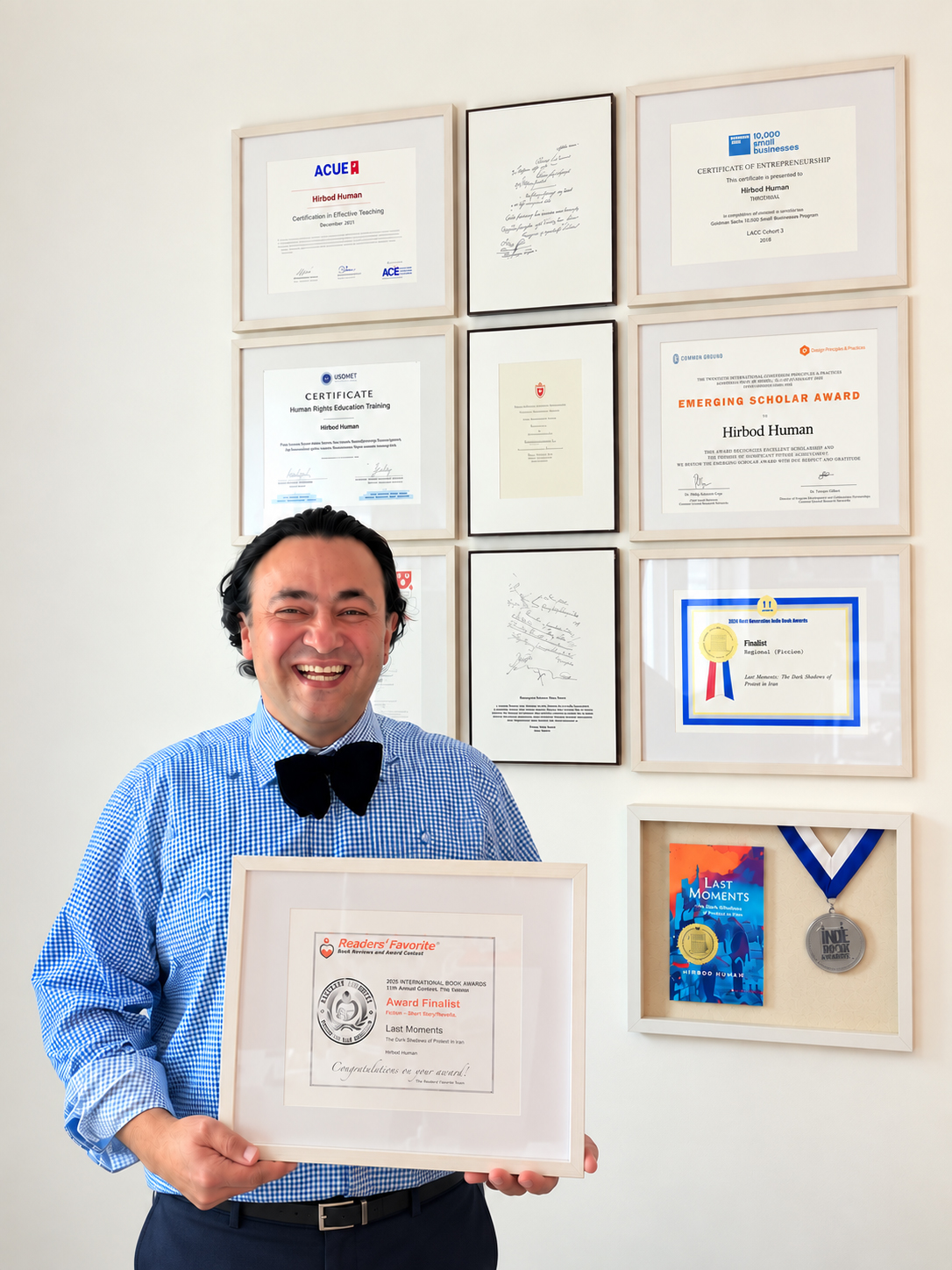
Hirbod Human is an Iranian-American award-winning scholar, author, filmmaker, curator, and multidisciplinary artist. His work examines how culture shapes human experience: how people perceive, remember, believe, and make meaning, and how embodied life, material surroundings, social structures, and inherited ideas shape those processes.
Human is pursuing a Ph.D. in Design, Aesthetics, and the Arts at Florida Atlantic University, where he is affiliated with the Center for Body, Mind, and Culture and works under the mentorship of philosopher Richard Shusterman. His research in pragmatist aesthetics and somaesthetics focuses on art, design, and atmosphere, asking how embodied experience and cultural context shape perception and belief.
In visual art and curatorial work, Human examines how objects, images, documents, and environments shape perception, identity, and the production of meaning. His studio practice is a form of research, developed through material and formal inquiry across sculpture, installation, design, and video art. In dialogue with his scholarship, these works consider how cultural and institutional frameworks guide interpretation and shape what becomes visible or valued. His research-based curatorial projects bring archival materials, educational perspectives, and overlooked histories into public encounter, inviting audiences to reconsider familiar narratives and the contexts that sustain them.
Human’s long engagement with cinema began with his studies in cinema art at Los Angeles City College in the mid-2000s and developed into a practice as a documentary writer, director, and producer. His filmwork addresses political history, human rights, and cultural subjects. Documentary media also extends his research to wider audiences: Baroque Bodies: Somaesthetics and the Art of Appearance, for example, developed alongside his research on fashion, the body, and power. At the Center for Cosmopolitan Culture, Human hosts, produces, and directs Cosmopolitan Currents. He also produces and directs atmospheres, hosted by Richard Shusterman and presented by Cosmopolitan Currents in collaboration with Florida Atlantic University’s Center for Body, Mind, and Culture.
Writing is a long-standing, personal practice that develops alongside Human’s life and thought. His literary work ranges across fiction and philosophical drama. Last Moments: The Dark Shadows of Protest in Iran is a collection of six short stories, informed by personal experience and interviews, that portrays the human consequences of political repression. His fable-like short works, including Dupi and Little Screw, explore captivity, recognition, purpose, and belonging through imaginative narratives. The Quiet Prophet turns to everyday objects and memory to consider perception and cultural inheritance. His play Divine Justice: A Play in Seven Scenes, scheduled for winter 2026, uses a biblical cadence to consider justice, authority, voice, and the relationship between humanity and the divine.
Having lived and worked in Tehran, Los Angeles, Las Vegas, Toronto, South Florida, and elsewhere, Human’s perspective has developed through encounters with different cultural settings. He founded TRIXMEDIA, a branding firm in Beverly Hills, Los Angeles, and Mayten’s Contemporary Art Gallery in Toronto. He was selected as one of 33 entrepreneurs from the western United States for the Goldman Sachs 10,000 Small Businesses program. His community work has also involved Iranian Artists Relief and The Power Plant Contemporary Art Gallery.
Selected awards and fellowships
Scholarly recognition and support
2026 — Newell Doctoral Fellowship, Florida Atlantic University.
2026 — Gulnar Bosch Travel Award, Southeastern College Art Conference (SECAC).
2026 — Emerging Scholar Award, 20th International Conference on Design Principles and Practices.
2025 — Newell Doctoral Fellowship, Florida Atlantic University.
2025 — Graduate Access Fellowship, Florida Atlantic University.
2024 — Art and Letters Fellowship Award, Florida Atlantic University.
Literary awards
2026 — Finalist Award Recipient, Readers’ Favorite International Book Awards, Fiction: Short Story/Novella, for Last Moments: The Dark Shadows of Protest in Iran.
2026 — Finalist Award Recipient, Next Generation Indie Book Awards, Regional Fiction, for Last Moments.
Artistic distinctions
2026 — Third Place, 3-Dimensional category, Fusion Art Still Life international exhibition, for Still Weighted.
2025 — Finalist, Future Frames exhibition, Merrill Gallery, University of Maryland, for video work Project No Witness.
Selected conferences and scholarly presentations
2026 — Research presentation, DEL Conference, “Should Design Move from a Discipline of Form to a Discipline of Experience? Applying Somaesthetics as a Framework for Embodied Design Practice,” Chavón, Dominican Republic, November 11–13.
2026 — Research presentation, SECAC Annual Conference, “Should Design Move from a Discipline of Form to a Discipline of Experience? Reinterpreting Universal Design Through Somaesthetics and Embodied Experience,” Winston-Salem, North Carolina, October 21–24.
2026 — Session chair and research presenter, 20th International Conference on Design Principles and Practices, Sapienza University of Rome.
2025 — Conference media director, Atmospheres of the Spiritual: Somaesthetic Explorations, Florida Atlantic University.
2025 — Panelist, “Somaesthetics and Embodiment in Photography: In Conversation with Dennis Church,” DIRT FRESH Exhibition Opening, Pompano Beach Cultural Center.
2025 — Speaker, “Dressing the Body, Structuring the Mind: Somaesthetics and Baroque Fashion,” Boca Raton Museum of Art.
2025 — Panelist, Baroque Bodies: Somaesthetics and the Art of Appearance, Boca Raton Museum of Art.
2025 — Joint panelist, screening and discussion of Persian Diary, Italy in Transit Symposium, Florida Atlantic University.
2024 — Conference media director, Somaesthetics of Atmosphere, Florida Atlantic University.
Selected exhibitions, screenings, curatorial projects, and public presentations
2026 — Participating author, Arts Launch Broward 2026, Broward Center for the Performing Arts, Fort Lauderdale, Florida; presentation and signing of Last Moments: The Dark Shadows of Protest in Iran and Divine Justice.
2026 — Co-curator and exhibiting artist, Micro/Macro; exhibited Sea Heart, Florida Atlantic University.
2026 — Curator, Soghati: Carried in Thread, MTN Gallery, Lake Worth, Florida. Scheduled for winter 2026.
2026 — Exhibiting artist, Fusion Art Still Life international exhibition; Still Weighted.
2025 — Exhibiting artist, Future Frames exhibition, Merrill Gallery, University of Maryland; video work Project No Witness.
2025 — Film screening, Baroque Bodies: Somaesthetics and the Art of Appearance, Boca Raton Museum of Art.
2024 — Guest curator, AMERICOLOR: Exploring Urban Color Fields, Palm Beach Atlantic University.
2024 — Exhibiting artist, Broken Screen, Broken System, Political Circus 2024, Schmidt Center Gallery, Florida Atlantic University.
2022 — Executive producer, Earth Oracles exhibition, Toronto.
Selected filmwork
2025 — Writer, director, and executive producer, Baroque Bodies: Somaesthetics and the Art of Appearance.
2023 — Writer, director, and executive producer, Vladimir Putin: Rise to Power (short documentary, Farsi).
2023 — Writer, director, and executive producer, Intellectual Rebellion (historical and political documentary, Farsi).
2023 — Writer, director, and executive producer, 44 Years of Terror (political documentary, English).
2023 — Writer, A Brief History of Cults (educational television documentary, Farsi).
2008 — Writer, director, and executive producer, Color Downfall (educational documentary, Farsi).
2005 — Writer, director, and executive producer, Banooye Sarbandan (biographical documentary, Farsi).
2004 — Writer and director, The Angel (short film, English).
Selected podcasts
2026 — Producer and director, atmospheres, Season 1; hosted by Richard Shusterman. Presented by Cosmopolitan Currents, Center for Cosmopolitan Culture, in collaboration with Florida Atlantic University’s Center for Body, Mind, and Culture.
2025 — Host, producer, and director, Cosmopolitan Currents, Center for Cosmopolitan Culture.
2023 — Co-writer, director, and executive producer, Hirbod and Hermes (psychology and sociology, Farsi).
2023 — Writer, director, and executive producer, Human Rights (educational podcast, Farsi).
2023 — Co-writer, director, and executive producer, Intellectual Rebellion (educational and political podcast, Farsi).
Community, service, and affiliations
Affiliations
Founding advisory board member, Authors AI.
Founding advisory board member, Binge Books.
Member, Association of Art Museum Curators.
Community and institutional work
2022 — Juror, Toronto Outdoor Art Festival.
2021–2022 — Co-designer, Entrepreneurship for Creatives micro-credential program, OCAD University.
2019–2022 — Founder and director, Mayten’s Contemporary Art Gallery, Toronto.
2019–2022 — Executive board member, The Power Plant Contemporary Art Gallery.
2019–2022 — Executive producer, Iranian Artists Relief.
2018–2019 — Committee member, The Power Plant Contemporary Art Gallery.
Certifications and professional development
2025 — ACUE credentials in effective teaching practices, productive learning environments, online inquiry, active learning, and learner-centered course design.
2023 — Certificate in Human Rights Consultation and Education, U.S. Institute of Diplomacy and Human Rights.
2016 — Certificate in Entrepreneurship, Goldman Sachs 10,000 Small Businesses program.
2016 — Certificate in Business Management and Education, Babson College and LACC.
Selected press, talks, and features
2026 — Featured author interview, “Inside the Moments That Changed Everything: Hirbod Human on Writing Last Moments: The Dark Shadows of Protest in Iran,” Miami Wire.
2026 — Featured collector, Collecting Art in The Palm Beaches, Cultural Council for Palm Beach County.
2022 — National media coverage, “Dissident Iranian Artists Deserve Our Support,” National Post, on Iranian Artists Relief.
2022 — Exhibition review, “Fierce and Fantastical Experiments in Ceramics,” Hyperallergic, on Earth Oracles at Mayten’s.
2021 — Featured speaker, “Art Collectors in Conversation with Hirbod Human and Farnoosh Talaee,” The Power Plant Contemporary Art Gallery.
Add comment